Objectives

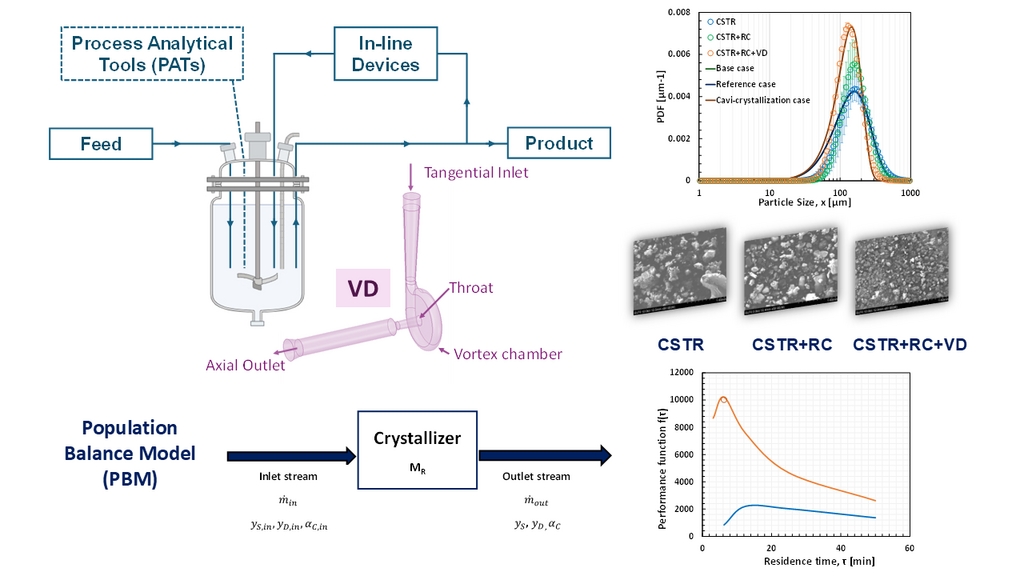
Develop a continuous antisolvent crystallization process integrated with hydrodynamic cavitation to investigate effects on the crystal size distribution and process performance.


Key findings

  • The performance of a continuous stirred crystallizer was augmented using a loop configuration
  • Use of vortex-based hydrodynamic cavitation enhanced nucleation and breakage
  • Developed a population balance model to simulate nucleation, growth, and breakage
  • The model was applied and validated for the optimization of crystallizer performance


Relevance

Provides a scalable and energy-efficient strategy for producing smaller, more uniform pharmaceutical crystals while maintaining high yield and productivity in continuous manufacturing.

More details may be obtained from: Tiwari, V., Swain, S., Wagh, R., Bari, A., Ranade, V.V., 2025, Chemical Engineering Journal 520, 166207. https://doi.org/10.1016/j.cej.2025.166207.
Objectives

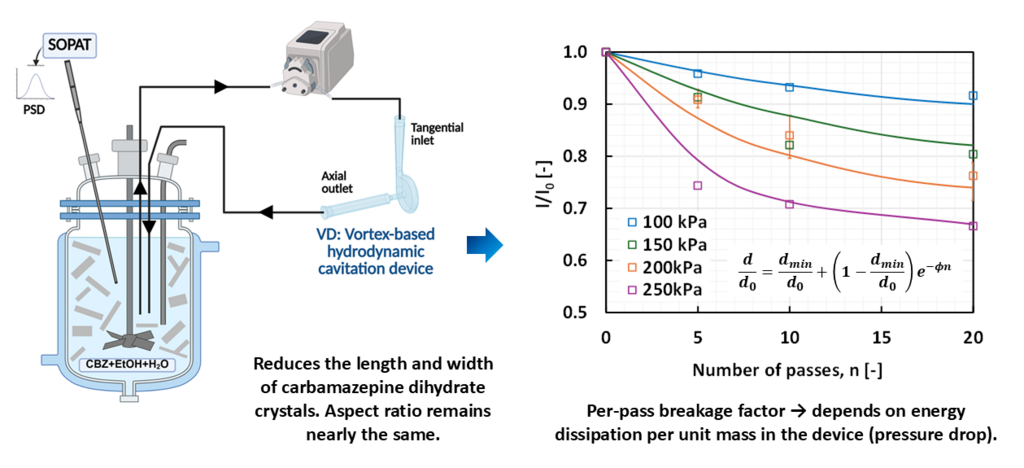
Investigate hydrodynamic cavitation-induced breakage of non-spherical crystals and develop a modeling framework to predict crystal size and shape in such systems.


Key findings

  • A vortex-based hydrodynamic cavitation device reduced the length and width of carbamazepine dihydrate crystals
  • Breakage showed fast and slow regimes, with most size reduction in 20 passes
  • Developed correlations to predict crystal size reduction as a function of operating conditions
  • The developed population balance model (one-dimensional) simulated breakage (length and width) across conditions


Relevance

Provides an energy-efficient alternative to conventional milling for tailoring pharmaceutical crystal size and shape while preserving crystal form and morphology.

More details may be obtained from: Swain, S.; Tiwari, V.; Ranade, V. V., 2025, Industrial & Engineering Chemistry Research 64, 20362–20375. https://doi.org/10.1021/acs.iecr.5c02950.

Objectives

Insert 2-3 lines elaborating on the objective of the current work.


Key findings

  • Finding 1
  • Finding 2
  • Finding 3
  • Finding 4


Relevance

The relevance of the current work.

More details may be obtained from: Chidambaranathapillai, S., Cravotto, C., Kamler, A.V., Nikonov, R.V., Sivakumar, M., Cravotto, G., 2025, Processes 13, 4033. https://doi.org/10.3390/pr13124033.

Objectives

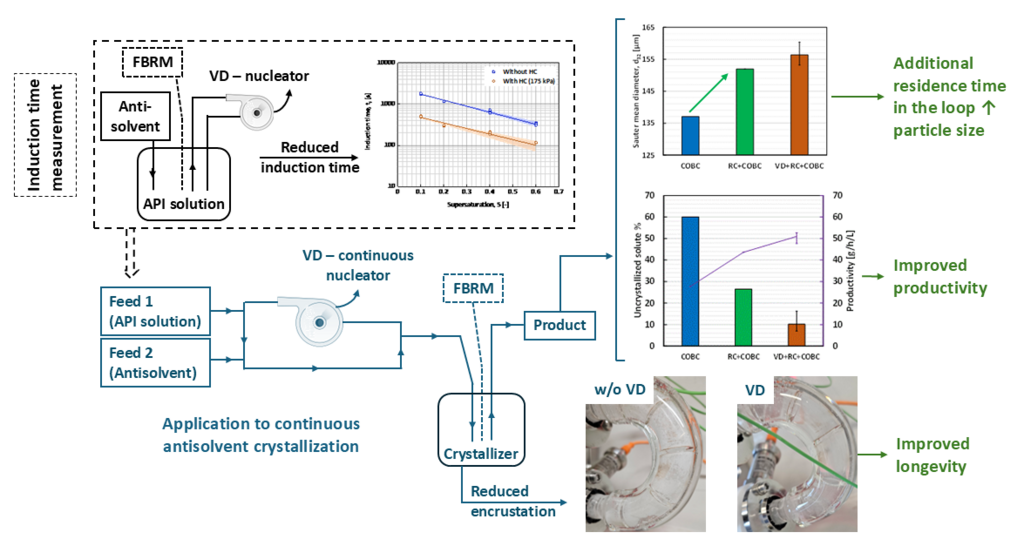
Investigate the use of hydrodynamic cavitation to enhance nucleation and intensify continuous antisolvent crystallization of paracetamol.


Key findings

  • Demonstrated use of Hydrodynamic Cavitation (HC) to enhance nucleation for the first time
  • Developed a correlation to quantify the effect of HC on induction time
  • HC-assisted nucleation led to a significant reduction in encrustation and fouling
  • Use of HC-assisted pre-nucleator before the continuous tubular crystallizer improved yield and productivity


Relevance

Provides a scalable and energy-efficient strategy to enhance nucleation, reduce fouling, and significantly improve yield and productivity in continuous pharmaceutical crystallization.

More details may be obtained from: Tiwari, V., Swain, S., Ranade, V.V., 2025, Ultrasonics Sonochemistry 123, 107668. https://doi.org/10.1016/j.ultsonch.2025.107668.

Objectives

Insert 2-3 lines elaborating on the objective of the current work.


Key findings

  • Finding 1
  • Finding 2
  • Finding 3
  • Finding 4


Relevance

The relevance of the current work.

More details may be obtained from: Toyran, E., Zupanc, M., Petkovsek, M., Dular, M., 2026, Ultrasonics Sonochemistry 125, 107741. https://doi.org/10.1016/j.ultsonch.2026.107741.

Objectives

Insert 2-3 lines elaborating on the objective of the current work.


Key findings

  • Finding 1
  • Finding 2
  • Finding 3
  • Finding 4


Relevance

The relevance of the current work.

More details may be obtained from: Liu, P., Chidambaranathapillai, S., Wu, Z., Cravotto, G., 2026, ACS Omega 11, 2384–2406. https://doi.org/10.1021/acsomega.5c08760.

Objectives

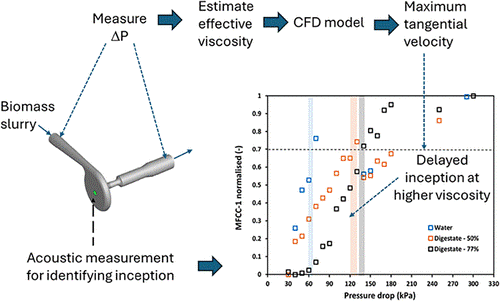
To investigate the influence of non-Newtonian, specifically shear-thinning fluid behavior, on the flow characteristics and cavitation inception in a vortex-based hydrodynamic cavitation device (VD) using experimental measurements and CFD simulations.


Key findings

  • Increasing digestate solids content and effective viscosity reduced pressure drop and weakened swirl intensity in VD
  • Higher effective viscosity delayed cavitation inception, increasing the inception pressure drop compared with water
  • CFD simulations showed good agreement with experimental pressure drop and velocity measurements for water and digestate slurries
  • Cavitation inception occurred at a critical tangential velocity of approximately 10 m/s, largely independent of fluid rheology


Relevance

Provide a foundation for the design and optimization of VD for processing complex fluids and slurries encountered in waste valorization and bioprocessing applications.

More details may be obtained from: Upadhyay, M., Rathod, J., Ranade, V.V., 2026, ACS Engineering Au XX, XXXX–XXXX. https://doi.org/10.1021/acsengineeringau.5c00121.

Objectives

Insert 2-3 lines elaborating on the objective of the current work.


Key findings

  • Finding 1
  • Finding 2
  • Finding 3
  • Finding 4


Relevance

The relevance of the current work.

More details may be obtained from: Khare, O.V., Ranade, V.V., 2026, Chemical Engineering Science 331, 124032. https://doi.org/10.1016/j.ces.2026.124032.

One temporary Early Stage Researcher, offered within Horizon MSCA-Doctoral Network CaviPRO

University of Turin

Summer School 2 to Take Place Online from 30 March 2026.

University of Ljubljana

Wrapping up 2025 with Quarterly Review Meeting.

Happy New Year 2026!

Subhrajit received the Most Pouplar Poster at the 54th Annual Conference of BACG, 2025.

The British Association for Crystal Growth

CaviPRO Summer School Kicks Off at Technische Universität Dresden on 24th March.

Technische Universität Dresden

Wrapping up 2024 with CaviPRO Quarterly Review Meeting.

Happy New Year 2025!

CaviPRO Induction School Kicks Off at University of Limerick on September 23, 2024.

University of Limerick

This project has received funding from the European Union’s Horizon Europe research and innovation programme under the Marie Skłodowska Curie Grant Agreement No. 101113564 [February 2024 – January 2028].


© CaviPRO: CaviPRO@ul.ie